


The Architecture of Agentic AI: Building Machines That Think, Act, and Evolve
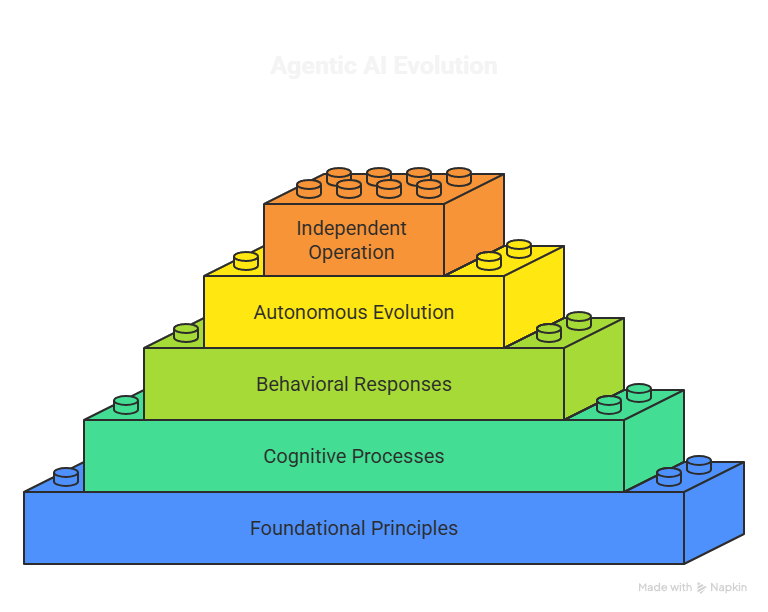
Artificial intelligence is changing fast, but the real leap isn’t just in bigger models or faster computation—it’s in systems that can act with intent. That’s what Agentic AI is all about: machines that don’t just process inputs, but observe, reason, and adapt within their environments. To understand how that works, let’s break it down layer by layer.
1. The Observation Layer – Seeing and Sensing the World
Every intelligent system starts with awareness. Before any reasoning or decision-making happens, the AI needs to understand its surroundings. That’s the job of the Observation Layer.
This layer functions like the AI’s sensory system. It gathers raw data—images, sounds, sensor readings, text streams, or API inputs—and translates them into something meaningful. You can think of it as the machine’s way of “looking” and “listening.”
But awareness isn’t just about perception; it’s about context. The Observation Layer helps the system figure out what matters right now by filtering noise and focusing on relevant data.
2. The Reasoning Layer – Turning Information into Understanding
Once the AI knows what’s happening, it has to decide what that means. That’s where the Reasoning Layer takes over.
Here, the data is analyzed, patterns are recognized, and relationships are formed. The system identifies what’s normal, what’s changing, and what might happen next. It’s like the brain’s cortex—where observation becomes understanding.
This layer often operates in two parts:
-
Interpretation: Making sense of what’s being observed.
-
Planning: Choosing a strategy or action based on that understanding.
What makes Agentic AI different is that its reasoning isn’t linear. It doesn’t just follow pre-set logic—it evaluates, predicts, and learns from experience.
3. The Action Layer – Translating Thought into Impact
Awareness and reasoning mean nothing if the system can’t act on them. That’s where the Action Layer comes in—the bridge between thought and movement.
This layer executes the chosen plan. It could be as simple as sending a response to a user, or as complex as managing a fleet of autonomous drones. The key idea is purposeful execution: the AI acts not just because it can, but because it has decided that it should.
Good design here means tight feedback—so the AI knows what effect its actions had and can adjust next time.
4. The Interaction Loop – Learning Through Experience
No intelligent system exists in a vacuum. Once an AI acts, it changes its environment in some way—triggering new inputs, outcomes, or constraints.
That updated information flows back into the Observation Layer, restarting the loop. Over time, this observe–reason–act cycle turns a static algorithm into a dynamic agent that learns from feedback, refines its strategies, and improves its performance.
This continuous loop is what makes AI Agent development powerful—it’s adaptive intelligence in motion.
The Bigger Picture: Designing for Intent
Agentic AI isn’t about replacing human decision-making—it’s about extending it. When built correctly, these layered systems can manage complex operations, anticipate needs, and respond to real-world changes in real time.
Whether it’s an AI assistant coordinating tasks across software tools or an autonomous system navigating unpredictable conditions, the structure remains the same: observe, reason, act, and evolve.
Final Thought: From Automation to Awareness
We’ve spent decades teaching machines to automate tasks. Now, we’re teaching them to understand why those tasks matter.
Agentic AI represents the next phase of intelligent design—machines that perceive, interpret, and act with purpose. It’s not about mimicking human thought; it’s about capturing the essence of awareness and adaptability in code.
When intelligence becomes layered, feedback-driven, and self-aware, we move closer to systems that don’t just process the world—they participate in it.
- Travel
- Equality
- Faith & Spirituality
- Beauty
- Writing
- Gaming
- Películas
- Music
- Tech
- Self Improvement
- Relationships
- Programming Languages
- Data Science
- Seguridad
- Blockchain
- Spirituality
- Educación
- Life
- Productivity
- Culture
- U.s Politics
- Health Politics
- Climate & Environment
- International
- Humor
- Philosophy
- Historial
- Mindfulness
- Relationships
- Creator Economy
- Business
- Marketing
- How To
- Lifestyle
- Art
- Causes
- Crafts
- Dance
- Drinks
- Film
- Fitness
- Food
- Juegos
- Gardening
- Health
- Inicio
- Literature
- Music
- Networking
- Otro
- Party
- Religion
- Shopping
- Sports
- Theater
- Wellness
 Spanish
 English
 Arabic
 French
 Portuguese
 Deutsch
 Turkish
 Dutch
Dutch
 Italiano
 Russian
 Romaian
 Portuguese (Brazil)
 Greek
Greek