


When Should You Consider Dust Collector Refurbishment?
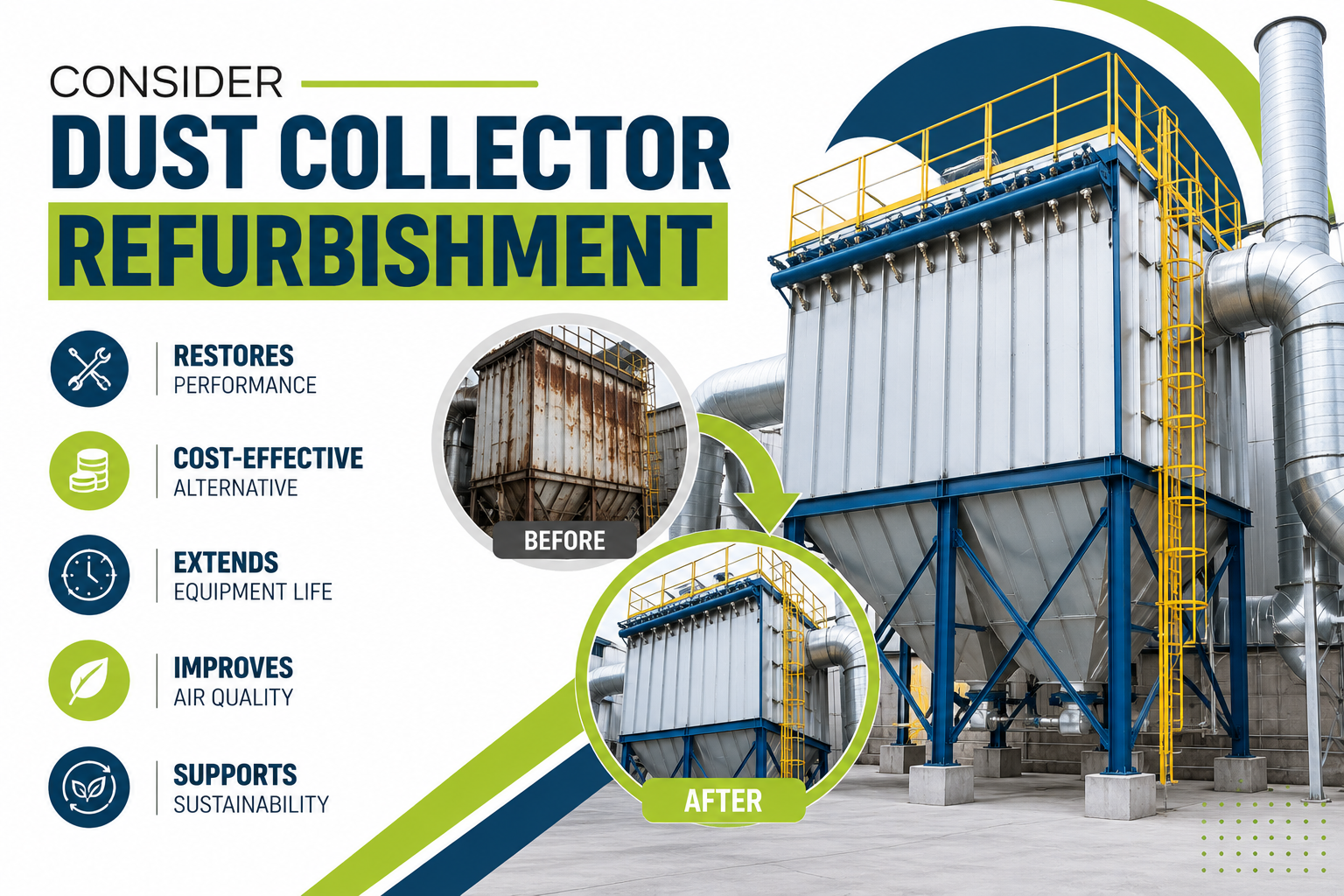
Industrial dust collectors work continuously to remove dust, fumes, and airborne particles from manufacturing environments. Over time, even a well-designed system can lose efficiency due to wear, clogging, corrosion, or outdated components. Refurbishing dust collectors can restore performance without the cost and downtime of replacing the entire system.
Knowing when refurbishment makes sense is important for maintaining air quality, protecting equipment, and controlling operating costs. Refurbishing of dust collectors is often worth considering when the main structure remains sound but key components are no longer performing efficiently.
Signs Your Dust Collector Needs Refurbishment
A dust collection system rarely fails without warning. Changes in airflow, pressure, noise, or dust leakage can indicate that the equipment needs professional attention. Regular dust collector maintenance can identify these issues before they develop into major failures.
Reduced Airflow and Suction
Weak suction is one of the most common signs of a problem. Filters may be clogged, ductwork may have leaks, or the fan and motor may no longer deliver the required airflow. If cleaning and basic servicing do not restore performance, a detailed inspection can determine whether dust collector refurbishment is appropriate.
Excessive Dust Leakage
Visible dust around the collector, hopper, duct connections, or clean-air outlet should not be ignored. Damaged filter bags, worn seals, faulty cleaning mechanisms, or corrosion may allow contaminants to escape. Refurbishment can involve replacing damaged parts and restoring the system's sealing and filtration performance.
When Repair Is Better Than Replacement
Not every aging dust collector needs to be replaced. If the housing, hopper, structural frame, and major components are still in usable condition, dust collector repair or refurbishment may provide a practical alternative.
A professional assessment should consider the collector's age, operating hours, filtration efficiency, pressure drop, energy consumption, and maintenance history. It should also determine whether the existing system can meet the factory's current production and emission-control requirements.
Components Commonly Refurbished
Depending on the condition of the equipment, refurbishment may include:
-
Replacing filter bags, cartridges, cages, seals, and gaskets.
-
Repairing damaged hoppers, ducts, access doors, and structural sections.
-
Servicing fans, motors, dampers, and dust discharge systems.
-
Upgrading cleaning systems, controls, and monitoring components.
These improvements can help restore airflow and improve the reliability of the overall dust extraction system.
Benefits of Refurbishing an Existing Dust Collector
A properly refurbished system can provide several operational advantages. Instead of investing immediately in a completely new dust collection unit, companies can upgrade essential components while retaining usable infrastructure.
Refurbishment may also reduce installation work and associated production interruptions. However, the decision should be based on the equipment's actual condition rather than its age alone.
What to Check Before Refurbishment
Before starting the project, companies should evaluate:
-
Structural condition: Check the housing, hopper, supports, and ductwork for corrosion or damage.
-
Filtration performance: Inspect filter bags or cartridges and measure pressure drop.
-
Airflow: Verify whether the system is delivering the required suction at collection points.
-
Energy consumption: Examine fan and motor performance for unnecessary energy use.
-
Future requirements: Consider production expansion and changes in dust load or material.
This assessment helps determine whether refurbishment can deliver the required performance or whether complete replacement is more suitable.
Avoiding Costly Dust Collector Decisions
Companies should also review the common mistakes companies make when buying industrial dust collection equipment, such as focusing only on the initial price, selecting an undersized system, or overlooking future production requirements. Similar mistakes can occur when deciding whether to refurbish an existing unit.
The right approach is to compare refurbishment costs, expected performance, remaining equipment life, energy efficiency, and future requirements. A qualified dust collection specialist can inspect the system and recommend the most practical solution.
Conclusion
Refurbishment can be a useful option when an existing dust collector has a sound structure but suffers from worn filters, poor airflow, leakage, corrosion, or outdated components. Professional inspection and dust collector maintenance can help identify whether repair, component replacement, or a complete upgrade is necessary. The goal should be reliable filtration, efficient airflow, controlled emissions, and reasonable operating costs. Before planning, assess the collector's condition and future requirements carefully. Contact Garant Filter for expert evaluation and customized industrial air pollution control solutions designed around your factory's specific dust collection needs.
- Travel
- Equality
- Faith & Spirituality
- Beauty
- Writing
- Gaming
- Кинозал
- Music
- Tech
- Self Improvement
- Relationships
- Programming Languages
- Data Science
- Безопасность
- Blockchain
- Spirituality
- Образование
- Life
- Productivity
- Culture
- U.s Politics
- Health Politics
- Climate & Environment
- International
- Humor
- Philosophy
- История
- Mindfulness
- Relationships
- Creator Economy
- Business
- Marketing
- How To
- Lifestyle
- Art
- Causes
- Crafts
- Dance
- Drinks
- Film
- Fitness
- Food
- Игры
- Gardening
- Health
- Главная
- Literature
- Music
- Networking
- Другое
- Party
- Religion
- Shopping
- Sports
- Theater
- Wellness
 Russian
 English
 Arabic
 French
 Spanish
 Portuguese
 Deutsch
 Turkish
 Dutch
Dutch
 Italiano
 Romaian
 Portuguese (Brazil)
 Greek
Greek