


OPC Cement Explained: Strength, Uses, and Ideal Applications
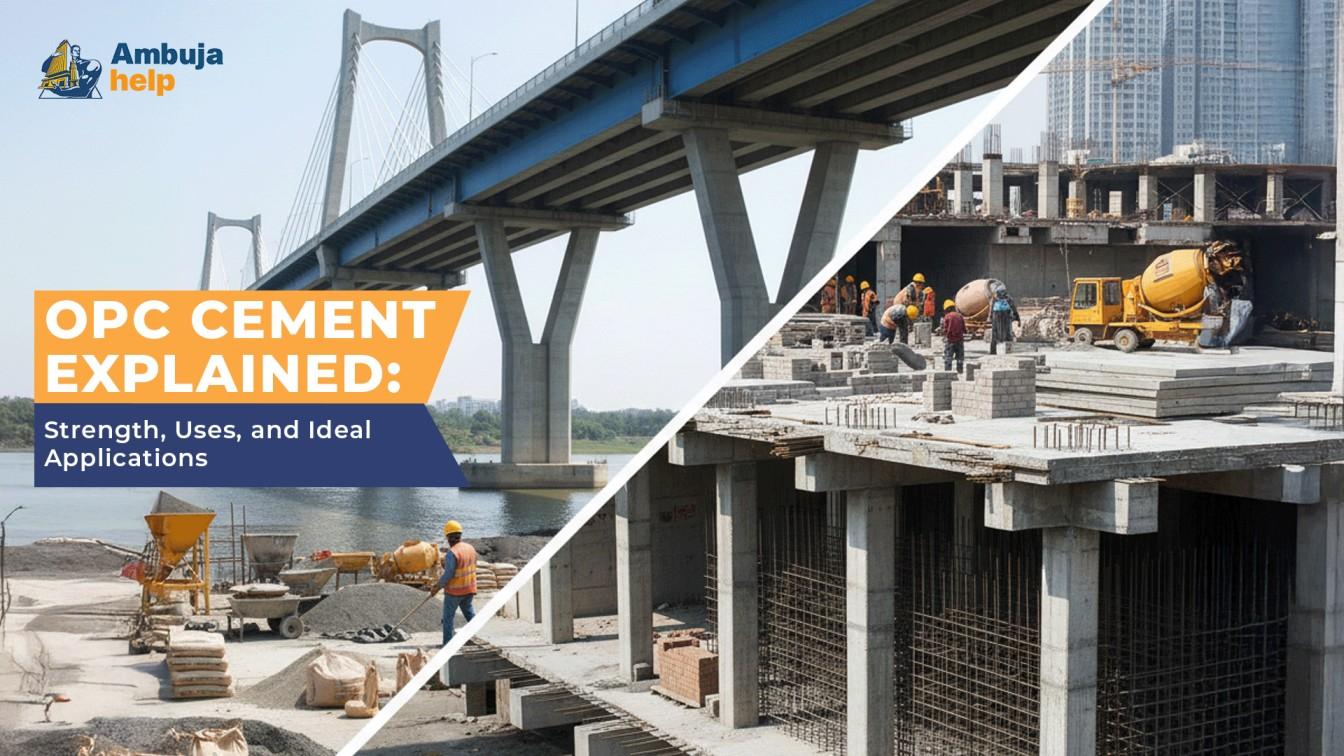
When it comes to building something that stands the test of time, the type of cement you choose makes all the difference. Among the various kinds available, OPC cement (Ordinary Portland Cement) is a widely used and trusted material across the construction industry. From homes and bridges to pavements and skyscrapers, its strength, reliability, and versatility make it indispensable.
This guide explores what OPC cement is, how it is made, its grades, properties, and where it is best used, helping you make the right choice for your construction needs.
What is Ordinary Portland Cement (OPC)?
Ordinary Portland Cement, commonly referred to as OPC, is a type of hydraulic cement that sets and hardens when mixed with water. It is manufactured by grinding Portland cement clinker with a small amount of gypsum to regulate the setting time.
When mixed with water, sand, and aggregates, OPC forms concrete or mortar that gains strength over time. It is often blended with supplementary materials like pozzolana or slag to produce other varieties of cement suited for different purposes.
Types of Ordinary Portland Cement
The Bureau of Indian Standards (BIS) classifies OPC into three grades based on their compressive strength at 28 days. Each grade has specific applications depending on the structural requirements.
|
OPC Grade |
Compressive Strength (N/mm² at 28 days) |
Applications |
|
OPC 33 Grade |
33 |
General construction, masonry, and plastering works |
|
OPC 43 Grade |
43 |
High-strength concrete work, flooring, and precast items |
|
OPC 53 Grade |
53 |
Precast and prestressed concrete, tall buildings, bridges, and heavy structures |
Each grade offers unique advantages. OPC 33 is suited for low-load constructions, OPC 43 provides balanced performance and workability, while OPC 53 is preferred where high early strength is essential.
Manufacturing Process of Ordinary Portland Cement
The making of OPC involves a series of precise steps, each designed to achieve the perfect blend of strength and durability.
|
Step |
Process Description |
|
1. Raw Material Sourcing |
Limestone and clay are mined from quarries and transported to the manufacturing plant. |
|
2. Grinding and Mixing |
The materials are ground into fine particles and mixed uniformly to form a homogenous blend. |
|
3. Heating in Kiln |
The mixture is heated in a rotary kiln at about 1450°C to form a clinker. |
|
4. Clinker Grinding |
Clinker is ground with gypsum to control the setting time of the cement. |
|
5. Storage and Packaging |
The final product is stored in silos and packed for distribution. |
This process ensures that the resulting cement has consistent quality, optimum fineness, and ideal chemical composition for long-lasting structures.
Chemical Composition of OPC
OPC derives its superior strength and durability from a balanced chemical composition:
|
Constituent |
Source |
Function |
|
Lime (CaO) |
Limestone or chalk |
Provides strength and binding properties |
|
Silica (SiO₂) |
Sand or clay |
Reacts with lime to form calcium silicates for strength |
|
Alumina (Al₂O₃) |
Clay or shale |
Accelerates the setting time and controls strength development |
|
Iron Oxide (Fe₂O₃) |
Iron ore |
Enhances hardness and colour |
|
Gypsum (CaSO₄·2H₂O) |
Natural gypsum |
Regulates the setting time |
These ingredients combine to form a durable cement matrix capable of withstanding high compressive forces.
Key Properties of Ordinary Portland Cement
|
Property |
Description |
|
Fineness |
Refers to particle size; finer cement leads to faster hydration and strength gain. |
|
Soundness |
Ensures the cement does not undergo excessive expansion after setting. |
|
Setting Time |
Time required for the cement paste to transition from plastic to solid state. |
|
Compressive Strength |
The maximum load the hardened cement can bear without cracking. |
|
Workability |
Ease of mixing, placing, and compacting the cement. |
These properties make OPC suitable for applications that require strength, stability, and quick setting.
Advantages of Using Ordinary Portland Cement
-
High Early Strength: OPC achieves higher strength in a shorter period compared to other cements, which helps speed up construction timelines.
-
Versatility: Suitable for all types of concrete construction, from slabs and beams to foundations.
-
Durability: Offers strong resistance to weathering, shrinkage, and cracking.
-
Sulphate Resistance: Performs well in environments exposed to mild sulphate attack, making it suitable for marine and coastal constructions.
-
Economical: Due to its wide availability and faster strength gain, it remains one of the most cost-effective choices.
Ideal Applications of OPC
OPC is used in a wide range of structural and non-structural works, including:
-
Residential and commercial buildings
-
Bridges, dams, and flyovers
-
Pavements and concrete roads
-
Railway sleepers (43-S and 53-S grades)
-
Precast and prestressed concrete elements
-
Masonry, plastering, and flooring
Tips Before You Buy Cement
When planning a construction project, choosing the right cement and ensuring its quality is vital. Always check the manufacturing date and ISI certification before purchase. If you plan to order buy cement online, ensure that it comes from a verified source to maintain product integrity and avoid counterfeit materials.
Additionally, store cement bags in a dry, covered space away from moisture to retain their performance properties until use.
Building with Confidence
Understanding how OPC functions and where it performs best empowers builders, engineers, and homeowners to make informed choices. Whether you’re constructing a high-rise structure or a modest home, using the right grade of OPC ensures safety, strength, and long-term stability.
With the convenience of being able to order online, quality materials are now easier to access, helping ensure every structure stands strong for generations.
- Travel
- Equality
- Faith & Spirituality
- Beauty
- Writing
- Gaming
- Filmes
- Music
- Tech
- Self Improvement
- Relationships
- Programming Languages
- Data Science
- Segurança
- Blockchain
- Spirituality
- Educação
- Life
- Productivity
- Culture
- U.s Politics
- Health Politics
- Climate & Environment
- International
- Humor
- Philosophy
- Histórico
- Mindfulness
- Relationships
- Creator Economy
- Business
- Marketing
- How To
- Lifestyle
- Art
- Causes
- Crafts
- Dance
- Drinks
- Film
- Fitness
- Food
- Jogos
- Gardening
- Health
- Início
- Literature
- Music
- Networking
- Outro
- Party
- Religion
- Shopping
- Sports
- Theater
- Wellness
 Portuguese (Brazil)
 English
 Arabic
 French
 Spanish
 Portuguese
 Deutsch
 Turkish
 Dutch
Dutch
 Italiano
 Russian
 Romaian
 Greek
Greek